
Create a Calm Corner That Helps Your Child Feel Safe
Learn how to create a calm corner that supports emotional regulation and discover thoughtful sensory swing options for your home.
AUTISM SUPPORT
BN
7/22/20263 min read

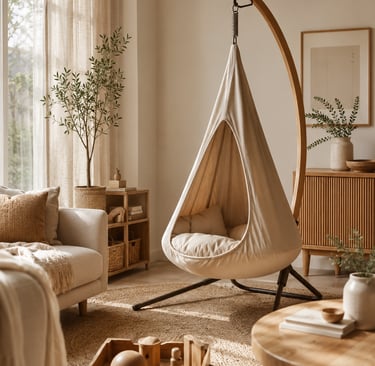
Sometimes, a calm corner isn't just another space in your home.
Sometimes, it becomes the place where both you and your child learn how to breathe again.
Five years ago, I wasn't looking for beautiful furniture or perfectly designed sensory spaces.
I was simply looking for anything that could help my son feel safe.
Our journey began long before words.
For the past five years, autism has become part of our everyday life. Four of those years were filled with therapy, learning, and trying to understand a world that often felt overwhelming for both of us.
Before he could communicate with words, anxiety often became his language.
His meltdowns and sensory overload were frequently triggered by needs he couldn't yet express. Sometimes I understood what was happening. Many times, I didn't.
As his mother, I often felt like I was trying to solve a puzzle without having all the pieces.
Every day became an opportunity to observe, learn, and slowly understand what his body was trying to tell me.
Learning to understand instead of simply reacting
One of the biggest lessons I learned was that there wasn't one magical solution.
Everything has its hard.
Waiting and hoping things would eventually change on their own was hard.
Learning, studying, practicing what therapists taught me, reading about autism, identifying triggers, making mistakes, and trying again was also hard.
I chose the second one.
Little by little, I learned to recognize the moments when I could prevent a meltdown, when I could reduce its intensity, and when the only thing I could do was stay with him, keep him safe, and help him through it.
What became part of our everyday life
There wasn't one single tool that changed everything.
It was always a combination of consistency, patience, and learning what helped my son feel safer in his own body.
Some of the things that became part of our daily routine were:
Deep pressure hugs.
Redirecting his attention before he became overwhelmed.
Holding his hands while we counted together.
Deep breathing.
Running and outdoor movement.
A small trampoline.
Weighted blankets.
And this sensory swing.
Every child is different.
What worked for us may not work the same way for another family.
But having different sensory tools available gave me more opportunities to support him while I continued learning how his nervous system responded to the world around him.
Why this sensory swing became part of our home

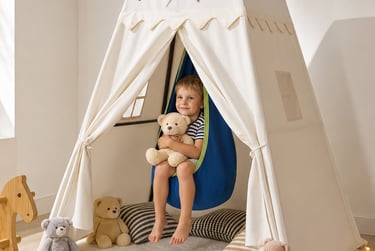
This wasn't a miracle product.
It didn't change everything overnight.
But it became one more tool that helped create moments of calm.
The gentle movement gave my son a predictable place where he could slow down, regulate his body, and feel safe.
Over time, it became part of our daily routine—not because someone promised it would work, but because I learned when it helped, how it helped, and when he needed it most.
Looking for a permanent option?

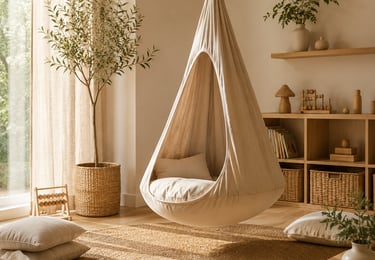
If you have a dedicated sensory room or prefer a permanent installation, a ceiling-mounted swing can be another wonderful option.
The most important part isn't choosing the "perfect" product.
It's creating a space your child learns to associate with safety, comfort, and regulation.
A note from one parent to another
I don't write these articles as a doctor.
I write them as a mother.
As someone who started from zero.
As someone who spent countless nights searching for answers, trying different approaches, celebrating small victories, and learning that progress is rarely linear.
Everything you'll find on The Triple Filter comes from that place.
Not from perfection.
Not from promises.
Not from miracle solutions.
But from lived experience, thoughtful research, and the hope that sharing what helped us might make someone else's journey feel a little less lonely.
If today you're where I was five years ago, I hope you know this:
You don't have to have all the answers today.
Sometimes the first step is simply creating one small place where both you and your child can breathe.
Buy Less. Choose Better.
© 2026 The Triple Filter
Contact
thetriplefilter@gmail.com
The Triple Filter Intentional living